Integration Hub : Product Description
Integration Hub (iHub) is the central framework for all much. Consulting integrations. It provides everything you need to install, configure, run, and monitor integrations between Odoo and external systems — from e-commerce platforms and accounting tools to custom APIs and file-based workflows.
Integrations
iHub is the single place to install, configure, and manage all your integrations. Each integration connects one Odoo company to an external system. Multiple integrations can run side by side — for example, one per sales channel or one per company in a multi-company setup.
Integrations follow a defined lifecycle: Inactive (not yet configured), Staging (connected to a test environment), and Active (connected to production). This ensures every integration can be safely tested before going live.

Scheduled actions (Jobs)
All automated sync workflows are driven by Scheduled Actions — recurring tasks that pull or push data between Odoo and the connected system at a defined interval. From Integration Hub you can view, activate, and configure all scheduled actions for all integrations in one place, without navigating to Odoo's technical settings.

Background Jobs
For longer-running operations — such as importing thousands of records — iHub can run tasks asynchronously in the background, without blocking the user interface. These Background Jobs track their own progress and state, collect any errors that occurred, and can be retried if something goes wrong
Logs
Whenever data flows between Odoo and an external system, iHub records what happened. Logs are categorised by severity — Info, Debug, Warning, Error, and Critical — giving you complete visibility into successful syncs as well as issues that need attention. Logs can be reviewed and marked as checked to track what has been looked at.

Mappers
Mappers bridge the gap between how values are named in Odoo and how they are named in your external system. For example, a tax rate called "20% VAT included" in Odoo might be referred to as "tax_20_incl" in your e-commerce platform — a Mapper ensures these two values are treated as equivalent during every import and export.
Mappers also support custom fields: if your external system stores data that has no equivalent field in Odoo, iHub lets you create that field directly in the relevant Odoo model.

Queues
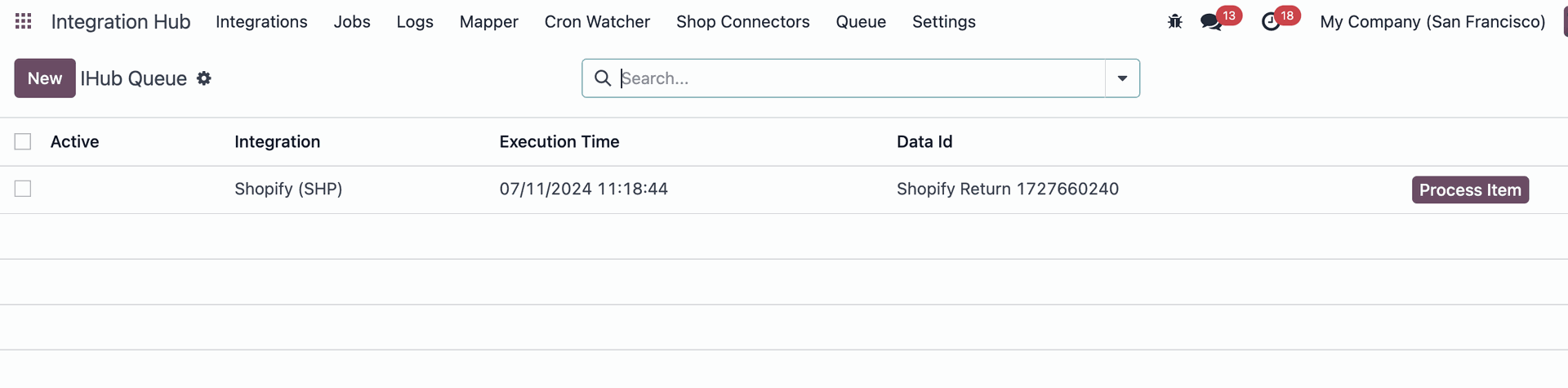
When external systems send data to Odoo in real time (for example via webhooks), the Queue feature stores incoming items and processes them in a controlled, ordered way — either automatically on a schedule or manually when you are ready. Failed items are retained for review so that nothing is silently lost.
Webhooks
iHub provides a built-in webhook endpoint that allows external systems to push data into Odoo in real time. When an event occurs in the external system — such as a new order being placed — it can immediately notify Odoo without waiting for the next scheduled sync. Incoming webhook payloads are typically handed off to the Queue for controlled processing.
Cronwatch
Cronwatch lets you monitor critical Scheduled Actions to ensure they do not stop running unexpectedly. When a watched cron job becomes inactive or is deleted, subscribed followers receive an automatic email notification so the issue can be addressed before it causes data gaps.
